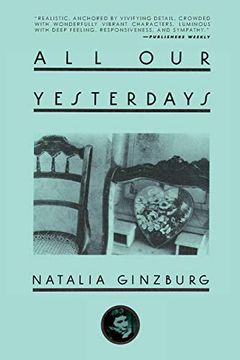
Reseña del libro "All our Yesterdays (en Inglés)"
From "one of the most distinguished writers of modern Italy" (New York Review of Books), a classic novel of society in the midst of a war. This powerful novel is set against the background of Italy from 1939 to 1944, from the anxious months before the country entered the war, through the war years, to the allied victory with its trailing wake of anxiety, disappointment, and grief. In the foreground are the members of two families. One is rich, the other is not. In All Our Yesterdays, as in all of Ms. Ginzburg's novels, terrible things happen--suicide, murder, air raids, and bombings. But seemingly less overwhelming events, like a family quarrel, adultery, or a deception, are given equal space, as if to say that, to a victim, adultery and air raids can be equally maiming. All Our Yesterdays gives a sharp portrait of a society hungry for change, but betrayed by war. During the period described in the novel, Natalia Ginzburg was married to the writer Leone Ginzburg. Because of his underground activities, he was interned under Mussolini's reign, along with his family, in a restricted area in the Abruzzi. When the Ginzburgs later moved to Rome, Leone was arrested and tortured by the fascists, and killed, leaving Natalia alone to raise her three children. Skyhorse Publishing, as well as our Arcade, Yucca, and Good Books imprints, are proud to publish a broad range of books for readers interested in fiction--novels, novellas, political and medical thrillers, comedy, satire, historical fiction, romance, erotic and love stories, mystery, classic literature, folklore and mythology, literary classics including Shakespeare, Dumas, Wilde, Cather, and much more. While not every title we publish becomes a New York Times bestseller or a national bestseller, we are committed to books on subjects that are sometimes overlooked and to authors whose work might not otherwise find a home.
Natalia Ginzburg (1916–1991) fue una destacada escritora italiana cuya obra abarca novela, ensayo, teatro y traducción. Nacida en Palermo y criada en Turín, vivió intensamente los efectos del fascismo y la Segunda Guerra Mundial, experiencias que marcaron profundamente su literatura. Su estilo se caracteriza por una prosa sobria y precisa, centrada en la vida cotidiana y las relaciones familiares. Entre sus obras más reconocidas se encuentran Léxico familiar (1963), que obtuvo el prestigioso Premio Strega, Las pequeñas virtudes (1962), Querido Miguel (1973), La ciudad y la casa (1984) y Todos nuestros ayeres (1952). También incursionó en el teatro con piezas como Me casé por alegría (1966).
Ginzburg fue una figura comprometida políticamente; participó en la resistencia antifascista y, más tarde, fue diputada por el Partido Comunista Italiano. Su obra ha influido en generaciones posteriores por su mirada íntima y honesta sobre lo doméstico como reflejo de lo universal. Además de su labor como escritora, trabajó en la editorial Einaudi, donde colaboró con figuras como Cesare Pavese. Su legado sigue vigente, especialmente por su capacidad para transformar lo cotidiano en literatura de alto valor ético y estético.
Ver más
Ver menos